


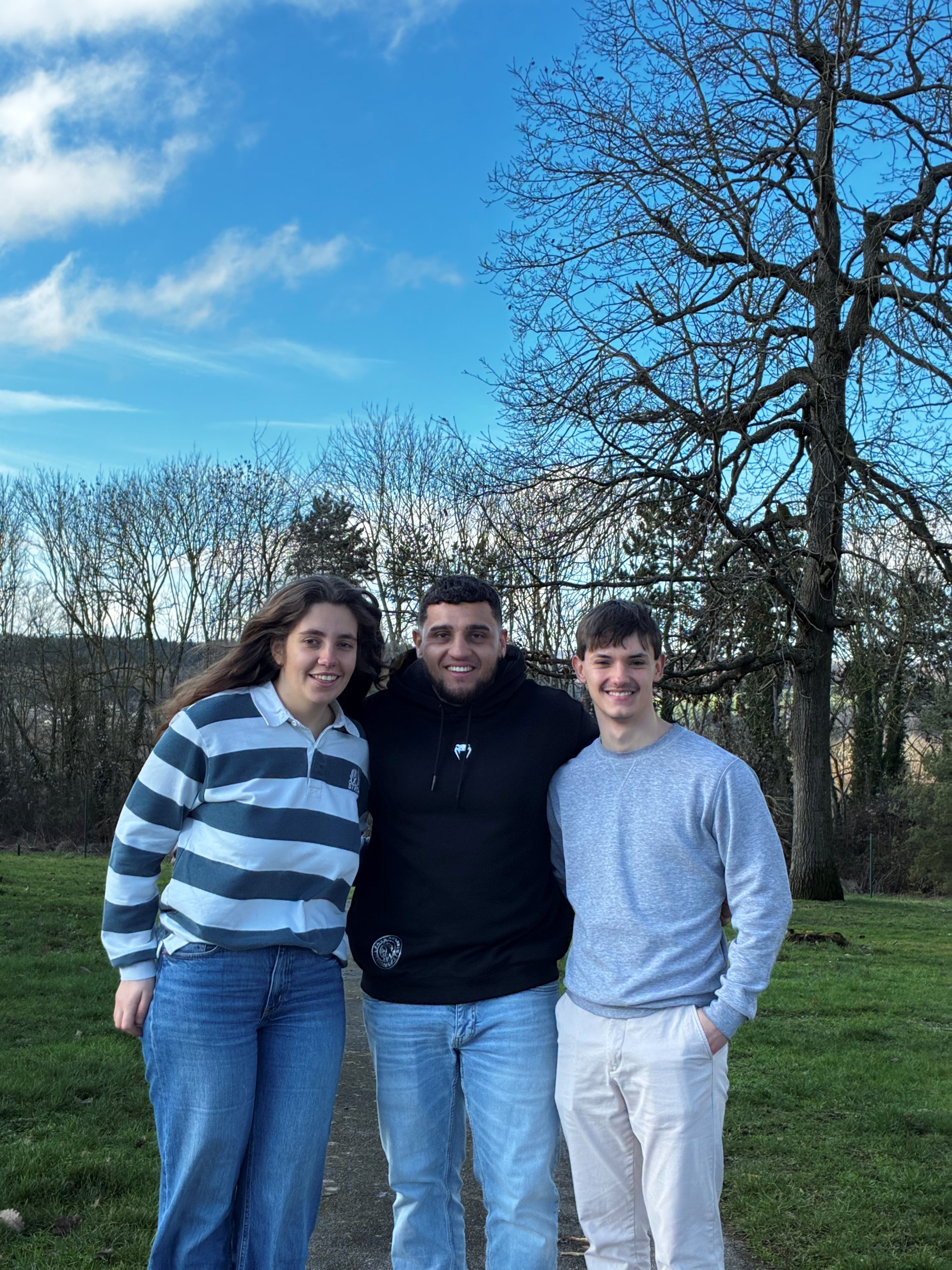
Alexis Esparon, Maëlys Ravel, and Noa Grand, fourth-year agricultural engineering and agro-industry students at UniLaSalle Beauvais, will defend their project at the collective Ovinpiades on February 21, 2026, at the International Agricultural Show.
A few days before their visit to the International Agricultural Show, three students studying Animal Sciences at UniLaSalle Beauvais are preparing to defend a project that fully illustrates the link between academic training and real-world applications. Their ambition is to use images to show how sheep contribute to the development of a region.
A collective project born in training
It was during their fourth year studying agronomy and agro-industries that Alexis Esparon, Maëlys Ravel, and Noa Grand decided to take up the challenge of the Ovinpiades 2026. Following a presentation on the sheep industry, the three students decided to form a group to represent their school.
The theme of this edition, “An aerial view of the sheep that bring life to the region,” invites the use of drones to illustrate the impact of sheep farming at the local level. This approach directly draws on their studies in livestock management, technical and economic analysis, and understanding of industry dynamics.
“We worked on the project from start to finish. It's not just a video, it's a real reflection on the role of livestock farming in our region,” explains Alexis, the project leader.
A unique farm in Oursel-Maison
To carry out their project, the students chose to visit a farm located in Oursel-Maison, in the Oise department. This was a deliberate choice: the farm is located in the heart of a cereal-growing region, in an area where crop production is the dominant industry.
This farm stands out for its unique system: a complementary sheep operation that makes use of plant cover after grain crops, with a herd that is mainly kept outdoors. The farmer relies on a high level of technical expertise, solid technical and economic references, and innovative tools to optimize his organization. This model demonstrates that it is possible to effectively integrate sheep farming into an agricultural landscape dominated by field crops.
“What interested us was showing that it is possible to produce differently, using existing land and creating value without necessarily specializing the entire system,” Maëlys points out.
Through this project, students apply the systemic and territorial approaches covered in their training at UniLaSalle Beauvais.
A professionalizing experience at the Salon de l'Agriculture
After an initial selection at the regional level, the team will defend its project on Saturday, February 21, 2026, at the Salon International de l'Agriculture, as part of the Ovinpiades. Their presentation will include the screening of the video, a five-minute presentation, and a discussion with a jury composed of stakeholders in the sheep industry.
Beyond the competition, this participation represents a major professional experience: public speaking, the ability to argue in front of professionals, and the promotion of a project built as a team.
“For me, it's more than a competition. It's an opportunity to show what we're learning in training and to directly compare it with the expectations in the field,” says Noa.
With just a few days to go before the competition, the three students are preparing to defend their project with seriousness and commitment. Everyone at UniLaSalle wishes them every success in the national final at the Salon de l'Agriculture.


