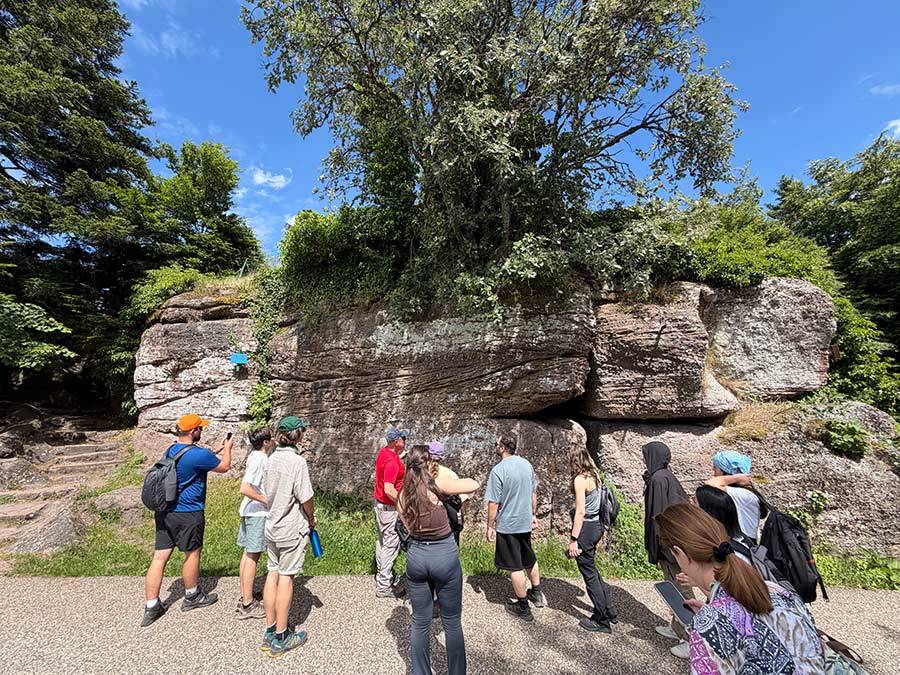
For one week in June, thirteen students from six European countries gathered in Beauvais for the first Erasmus+ Blended Intensive Program hosted on campus. At the heart of this cooperation project led by UniLaSalle was an in-house educational innovation: a collaborative virtual reality experience designed to allow participants to explore inaccessible mine galleries together.
It all began with a European project. Bringing together thirteen students from the Czech Republic, Lithuania, Croatia, Austria, Germany, and Romania to study structural geology and the challenges of the energy transition required a great deal of coordination: establishing agreements with partner universities, developing the program, organizing student exchanges, and welcoming each student upon arrival. Beauvais’s international office, working closely with faculty member and researcher Ghislain Trullenque, established this framework. And it was within this framework that a remarkable pedagogical innovation took place: for one week, these students alternated between online classes, virtual reality immersion on campus, and field trips in eastern France. At the heart of the experience was a project developed entirely in-house at UniLaSalle: a collaborative virtual-reality tour of mine galleries, where ten people explored together a site that would otherwise be impossible to reach.
Reconstructing a reservoir that is millions of years old
It all starts with a research question. To understand how fluids containing critical elements circulate in deep geothermal reservoirs, geologists cannot rely solely on drilling, which is costly and incomplete. Instead, they study reservoir analogs: ancient reservoirs brought to the surface by tectonic movements, where mineralized fluids have left their mark in the form of veins mined for their minerals.
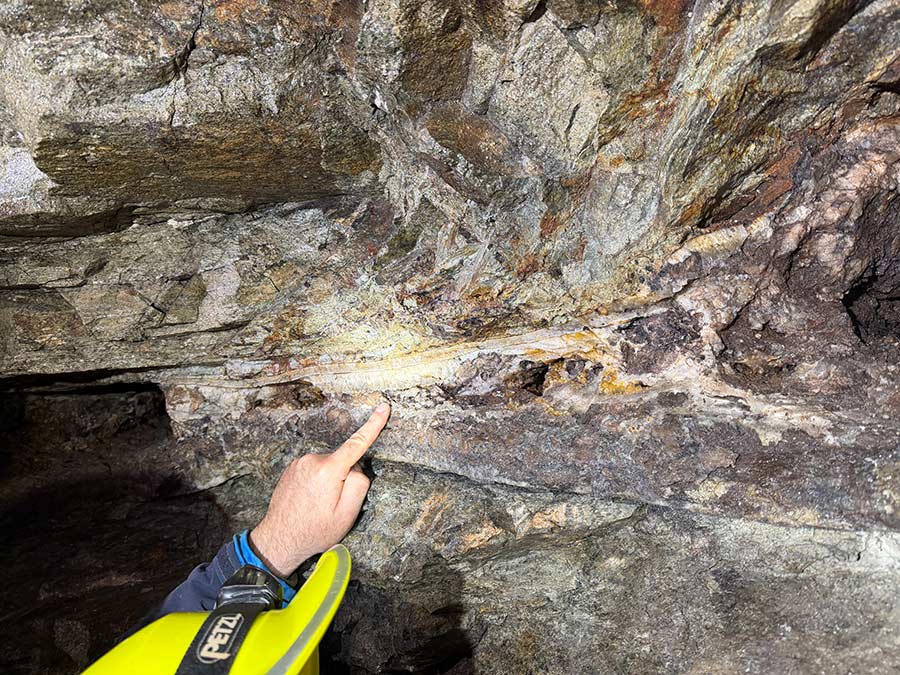
Two galleries serve as the basis for the experiment: one in the German Black Forest, at Schauinsland, and the other in the Vosges Mountains, in France. Their deformation structures complement each other, and together they make it possible to reconstruct a model of fluid circulation and shed light on the geology of the Rhine Graben, from the earliest tectonic cycles to the present day.
The data were acquired as part of a European H2020 research project led by UniLaSalle. On site, powerful spotlights were used to fully illuminate the tunnels during filming: a crucial detail, because in virtual reality, visitors can see the entire tunnel at a single glance, whereas geologists in the field can only see the portion illuminated by their headlamps.
A guided tour with a group, controllers in hand
In the experiment, students do not watch a movie. They take a guided tour led by their teacher, just as they would in a real museum. They observe the structures, measure distances, and map fault lines. They can stay together behind the teacher or split into teams at different points of interest, with up to ten people connected simultaneously.
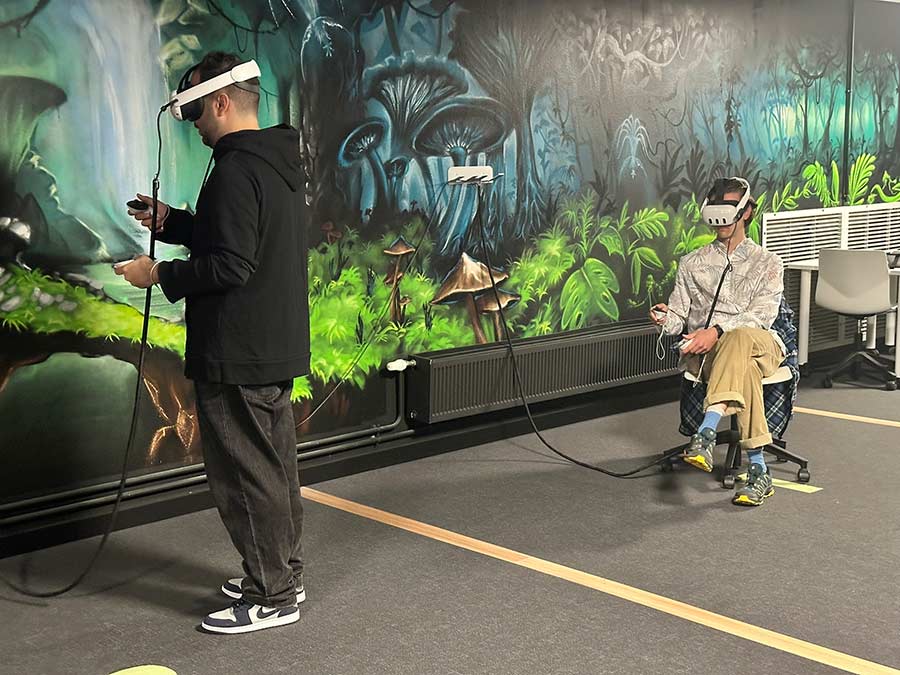
The appeal goes beyond mere convenience. Organizing a trip to these mines involves driving hundreds of kilometers, paying an entrance fee, taking a grueling hike, and strictly adhering to safety rules—all while never ruling out the risk of a fall or accident. The virtual version makes the site accessible to everyone, every day, in complete safety.
“A gallery like this, for example, is completely inaccessible to a person with limited mobility. In virtual reality, however, it is no longer inaccessible,” explains Ghislain Trullenque, a professor and researcher with HDR status in structural geology
This benefit also applies to research. Time spent in the field is always limited, and it sometimes happens that you leave a tunnel without having observed a particular area. In virtual reality, the geologist has all the time needed, can return as often as desired, and works in a perfectly lit scene.
A European program
Behind this week lies several months of planning. The idea of a geological field camp already existed, carried over from the Geo3EN project, but the addition of virtual reality gave it a new lease on life. For this edition, planning began as early as October, culminating in the students’ arrival on June 14. The international office developed new partnership agreements in Europe, circulated the call for applications to geosciences universities, and then managed the selection process: 21 applications were received for 16 spots, and ultimately thirteen students attended, representing six institutions, ranging from Vilnius University to the Czech University of Life Sciences in Prague, including the University of Zagreb, USAMV Cluj-Napoca, Hochschule Bochum, and BOKU Vienna.
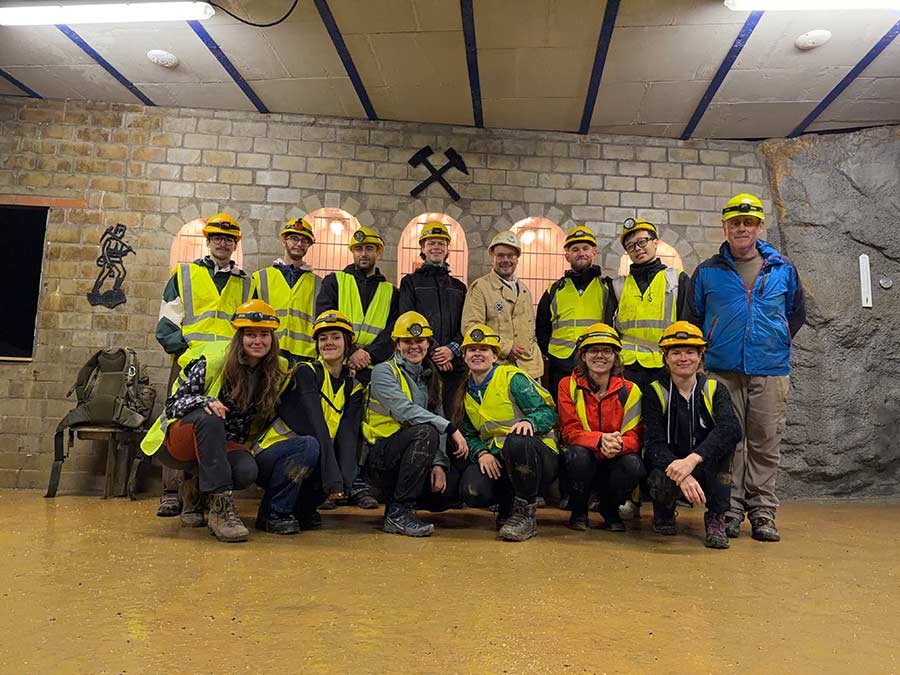
The format itself adheres to the specific framework of the Erasmus+ Blended Intensive Programs: an online phase—in this case, nine hours divided into three sessions—followed by a week of in-person instruction. The entire program was conducted in English and earned 3 ECTS credits for participants. It is also the first BIP hosted on the Beauvais campus, and it will not be the last: others are already scheduled as part of the Erasmus+ funding secured by the school, with a new edition planned for next year.
The key to effective teaching lies in the sequence of activities. Several participants were not geologists by training, yet all grasped the combined approach: they prepared online, immersed themselves in virtual reality to visualize the structures beforehand, and then tested their understanding against the real-world environment in the field, all the way to Alsace. From modeling to direct observation, the students connected structural geology, geothermal systems, and critical raw materials—all central to the challenges of the energy transition.
A Path Toward More Accessible Education
This project was born out of a collaboration between the research team, the digital team, and the international office. It bears the signature of Ghislain Trullenque, a professor and researcher with HDR status in structural geology; Noam Le Garsmeur, a virtual reality intern with the APEX team; and the Beauvais international office, which established the European framework without which this week would not have been possible. Beyond the technical feat, it paves the way for geoscience education that is more accessible, more flexible, open to Europe, and firmly rooted in research.