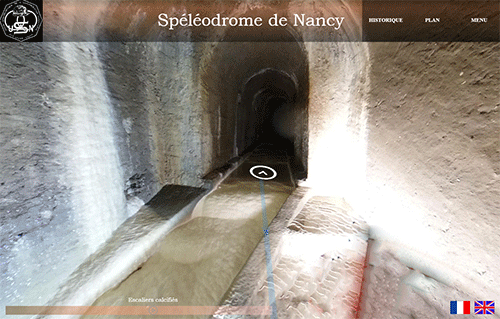
Near Nancy, there is a surprising place that is of great interest to geologists and hydrogeologists: the Spéléodrome. Originally built to supply the city of Nancy with drinking water, this underground aqueduct was abandoned in the 1930s. Today, it serves as a playground for our faculty researchers and geosciences and environmental engineering students, who return there regularly for research projects or academic work. Why? Calcite concretions—which are usually found in natural caves—form there at breakneck speed, and millions of cave pearls accumulate on the ground.
Among our regular visitors are Élise Chenot and Réjanne le Bivic, both faculty members in the Geosciences Department at UniLaSalle. They explain why the Spéléodrome is a fantastic place for our students to study, as well as for research aimed at reducing CO2 emissions into the atmosphere.
What exactly is the Nancy Spéléodrome?
The Nancy Spéléodrome is an underground aqueduct built in the late 19th century on the hills above Nancy to address public health concerns. At that time, drinking water came mainly from the Moselle River, which was extremely polluted due to the region’s intense steel industry activity. To address this problem, Edouard Imbeaux sought another source of drinking water and came up with the idea of tapping into the perched aquifer on the Haye Plateau, high above Nancy. This mountain range, covered in forest and free of human activity, consists of fractured limestone into which rainwater seeps. He therefore had the brilliant idea of digging a tunnel beneath the aquifer to draw drinking water from below, using a drainage system installed in the ceiling.
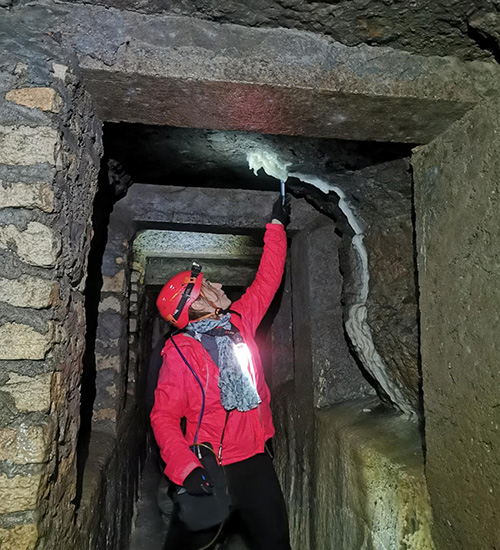
Why is it important to understand the formation of calcite pearls at the Nancy Speleodrome?
The limestone that forms in our kitchen kettle is the result of a natural chemical process in which carbon dioxide (CO2) precipitates as calcite. In short, this can be described as the transformation of a greenhouse gas into stable rock.
The underground river that flows through the Nancy Speleodrome is filled with millions of calcite beads. That’s a considerable amount. Clearly, a physicochemical or biochemical process has been transforming CO2 into calcite in this tunnel over the past 120 years. It’s quite unique!
Why here? How? At what rate? Why in this spherical form? This raises many questions.
What future impacts might this research have on the scientific community?
The mineralization of CO2 into rock is already a hot topic in research today as a way to address the challenges of climate change.
There are numerous studies and engineering tests attempting to replicate this phenomenon, including, among others, a large-scale experiment in Iceland. CO2 is injected several hundred meters underground into basalt. After a few years, scientists observed that the CO2 transforms into rock within the pores of the basalt. This process is currently the cleanest and most advanced artificial solution for CO2 mineralization, BUT it remains energy-intensive and, above all, water-intensive! Furthermore, for this chemical reaction to occur rapidly, very specific conditions are required: CO2 must be injected into basalt at very great depths to find the physicochemical conditions favorable to this reaction.
Inside the Nancy Speleodrome, it appears that this process occurs naturally—but 50 meters beneath our feet! It is therefore of interest to us to understand the local mineralization process so that we can then develop technological solutions capable of replicating this phenomenon on the surface. Thus, after capturing CO2 at the factory outlet, we could potentially transform it into rock right on site!
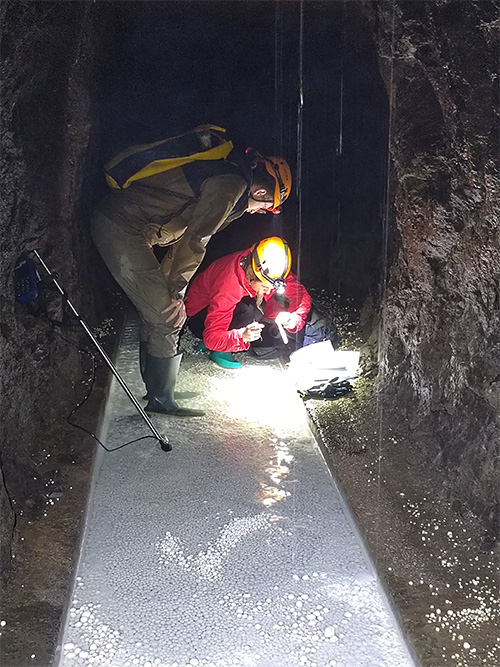
What role did UniLaSalle students play in this project, and how do they benefit from participating in research activities?
The students actively contributed to obtaining the initial hydrogeological results and to the site’s development through projects such as creating virtual tours of the tunnel, designing site models, collecting water samples, and gaining an understanding of the local geology.
Some of the students’ projects were presented at a national Earth sciences conference.
What has surprised you the most about this research project so far?
This aqueduct was built 120 years ago to address drinking water supply issues in the city of Nancy.
Ultimately, today, that original objective has been completely abandoned, and it seems that what has been happening there for a century is actually helping us solve current problems.
Did you know?
Geology & Environmental Engineering students at UniLaSalle created a virtual tour of the Spéléodrome in Nancy.
This meticulous project required hundreds of photos taken in conditions of constant cool temperatures and humidity.