


Philippe Pouillart, an immunopharmacology researcher turned chef, is celebrating his 30th anniversary at UniLaSalle. In the school’s kitchens, he has worked with patients to develop a resource that thousands of families affected by cancer use every year—often without knowing where it comes from. In the midst of Pink October, here is a portrait of a man and his conviction: eating is part of care.
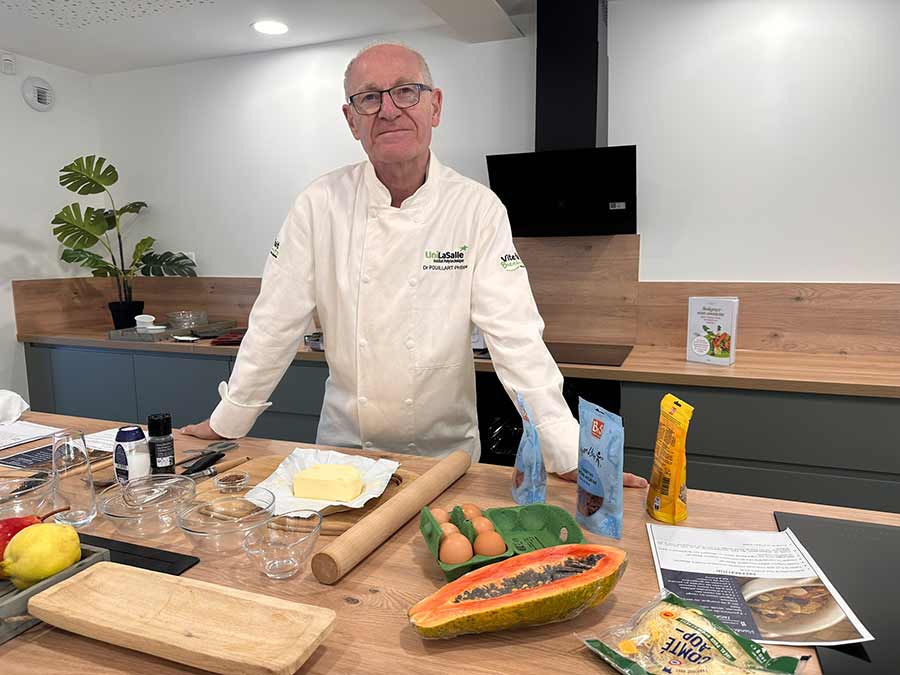
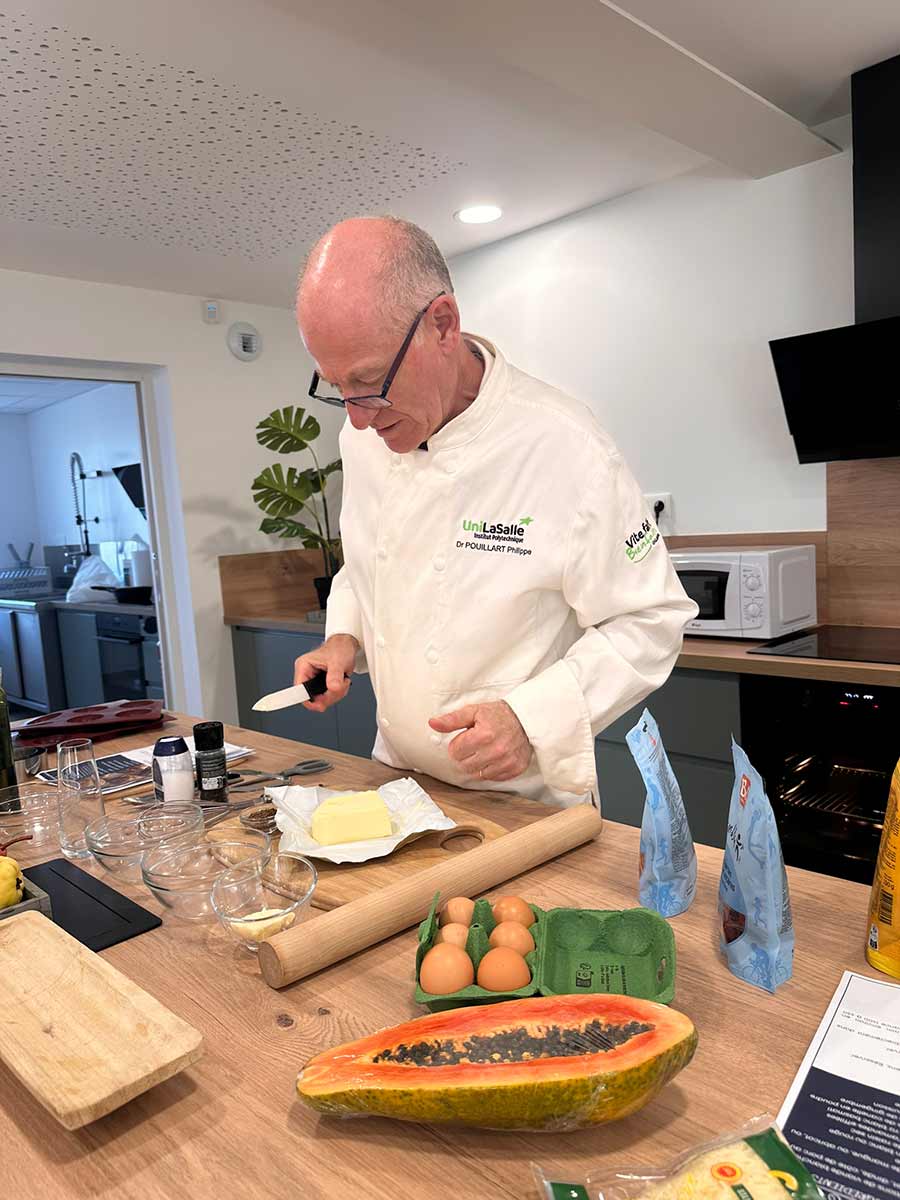
In the kitchen of the HealthLab at UniLaSalle Beauvais, the cameras are rolling. No stainless steel, no high-end restaurant equipment. A kitchen just like at home, with inexpensive utensils, and all the teaspoons neatly arranged in the right drawer. Philippe Pouillart adjusts his microphone. On the screen, the connections are piling up: Oise, Nord, Réunion, the Antilles, Saint-Pierre-and-Miquelon. The schedule was chosen with them in mind. “I’m sorry for our friends in Polynesia and New Caledonia—the time difference is too great.”
An hour and a half of cooking—appetizer, main course, dessert—followed by a live Q&A. The participants received the recipes a week in advance, giving them time to go grocery shopping. On today’s agenda: two symptoms. How do you make roast chicken when you’re feeling nauseous? How do you season mashed potatoes when you’ve lost your sense of taste? Behind the camera were Gauthier Brisset and Jordan Sturm, former students at UniLaSalle. The patients themselves came up with a name for this event: onCOOK.
None of this should ever have happened. Philippe Pouillart should never even have settled in Beauvais.
The Patient in the Locked Room
It all starts with a researcher working on cancer biology. INSERM, CNRS, a Franco-American pharmaceutical company, patents, clinical trials. “It went well.” And then one day, in a hospital, a closed room. The doctor leading the study tells him that the patient they were monitoring died during the night. As far as the study is concerned, he’s told, the case remains valid: based on all biological criteria, the patient had been saved. “He died cured.”
“He was cured, yet he died.” That phrase has stayed with him ever since. “I said, ‘Why did he die, then? He was malnourished. That patient was extremely malnourished.’ ” On paper, everything looked fine. But inside the body, the disease drains energy, the treatment drains even more, and in the end, the patient has no reserves left. According to the studies he cites today, malnutrition accounts for a 5 to 25 percent excess mortality rate among cancer patients.
He decided to leave the laboratory to start his own company in Compiègne: to test “health foods” on pigs, whose digestive tracts resemble our own. In 1996, he knocked on the school’s door as a potential partner—nothing more. On the other side were Pierre Quéméré, director of research, assisted by Francis Willequet, and André Blanchard, director of ISAB (Institut supérieur agricole de Beauvais), the former name of UniLaSalle. They showed him an unused laboratory. “I discovered that the project I was supposed to carry out in Compiègne already existed here, under even more favorable conditions. That evening, they told me: ‘Sign a fixed-term contract and abandon your project.’” An eighteen-month contract to get everything up and running. Thirty years later, he’s still there.
He created the “Food and Health” concept and established the AGROSANTE Specialization Track in the fifth year of the program as it existed at the time. Then, Philippe Choquet, who joined the administration shortly thereafter, set a course for the duo of Philippe and Francis to develop the concept into a five-year engineering program. The program launched in 2001: “We did it, and off we went!” he sums up, his eyes sparkling.
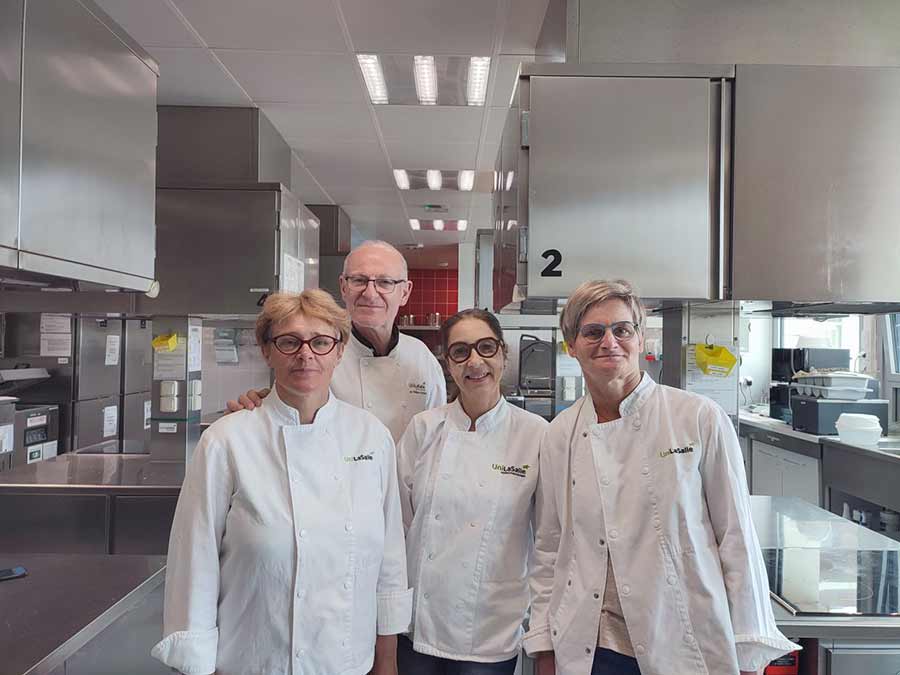
He successively established and directed the institute’s preclinical testing facility, followed by the culinary practice facility. And since teaching cooking without knowing how to cook makes no sense, he earned his CAP in culinary arts alongside his students, then a degree in restaurant management, trained in bistronomy, and finally in healthy cooking under Michelin-starred chef Michel Guérard. “There are only four of us in France who hold a doctorate in a field and have this recognized level of culinary expertise.” The certificate in therapeutic patient education that he obtained qualifies him to work with patients and thus to conduct action research studies within the Health College.
Twelve patients to come up with everything
Talking with patients. That’s what changed everything in 2010.
Until then, the curriculum had focused on teaching future food-industry engineers about healthy eating. “And then we realized that there were also patients who needed to cook—or their caregivers.” Knowing what to eat isn’t enough; you also have to be able to prepare it. So he reached out to those most directly affected, working with the Beauvais Hospital Center and patient associations in the Oise region. He interviewed 197 patients at their bedsides, while they were receiving IVs, right in the middle of July. He asked 160 questions. One figure struck him more than the others: 16% of those surveyed could no longer enter their kitchens. “It’s crazy. You wonder: how do they manage?” ”
Some told him they’d found solutions, ways to adapt, and workarounds. At the end of the survey, he asked: Who wants to help us next?
Twelve women. For seven years, once a month, ten months a year, they gathered at the culinary practice platform—brand-new at the time. He cooked with them, and they advised him over his shoulder, step by step. “Methodologically, we’re engaged in co-construction; we’re conducting action research.” Five to six hundred recipes emerge from these sessions. None are validated without verification by doctors and dietitians and are disseminated through scientific publications.
Among the twelve is Agnès. She has battled several cancers, undergone grueling treatments, and possesses an energy that sweeps everything along. In the videos shot back then, she’s the one who asks for the microphone. When a newcomer arrives looking sad, she’s the one who takes her by the arm: “Don’t worry, we’re going to the kitchen—you’ll see, I’ll show you some tips.” For seven years, he says, she was the one who held the group together.
Vite Fait Bienfaits : le site né dans cette cuisine
Entre 2010 et 2015, les recettes s'accumulent et Philippe Pouillart multiplie les passages à la télévision. On lui conseille d'en tirer un livre. Il refuse : ce qu'il veut, c'est un site internet, consultable depuis n'importe quelle cuisine en Francophonie. En 2017 naît Vite Fait Bienfaits, construit avec les patients.
On y entre par le symptôme, jamais par la maladie. Nausées, aphtes, perte du goût, transit, fatigue : un cancer peut perturber jusqu'à 70 aspects de l'alimentation, et chacun des symptômes majeurs trouve une réponse dans l'assiette. Pas une solution miracle, une astuce pour continuer à manger. Une pointe d'acidulé dans une purée fade. Des épices et des herbes choisies pour ne pas interagir avec les médicaments. Une pomme de terre cuisinée autrement que dans l'eau qui en extrait tout le goût. Le micro-ondes, que d'autres décrient, réhabilité par les malades eux-mêmes.
Why “Vite Fait Bienfaits”? Because the site is designed for those days when you’re running on empty. “It’s 4 p.m., and I wasn’t able to eat with the family. Okay, what’s in the fridge? I feel like making some ratatouille. We’ll eat in fifteen minutes.” ”
Today, the site gets over 180,000 visits per year. Some 20,000 families return regularly, and healthcare professionals use it. When it came time to update the site, patients were clear: “This site is our site—we’ve bookmarked it. Don’t change it too much. ” Gauthier Brisset and Jordan Sturm are now adding short videos: how to organize your refrigerator, how to shop at the farmers’ market or a supermarket, and why a can of sardines can be a lifesaver when you’re sick.
onCOOK: The Cooking Class That Spans the Atlantic
The website is up and running. All that’s missing is the live component. The COVID-19 pandemic in 2020 did the rest: Cyril Lignac was hosting “Tous en cuisine” on TV, and Philippe Pouillart thought it was a good idea. But he doesn’t make decisions on his own. As coordinator of the Nutrition Group at Onco Hauts-de-France, the regional cancer network, he consulted with hospitals, organizations, doctors, and pharmacists. Virtual reality headsets? Tested, then abandoned: “They make me feel nauseous more than anything else.” Video tips on social media? Too short for an audience 70% of whom are over 50. The answer is clear: live workshops.
Why online, when workshops are available in person at hospitals? Because they aren’t accessible to everyone. “You don’t want to travel miles; you don’t want to be seen because you’ve lost your hair; you’re exhausted for three days. Is the workshop four days after your chemotherapy? No, you don’t go.” onCOOK doesn’t replace in-person workshops—it complements them—and a scientific study has proven it. Twelve major symptoms over six months, then we start over with new recipes—“otherwise it wouldn’t be any fun.” Caregivers requested shorter versions to review: appetizer, main course, dessert—all available on the website. And when the opportunity arises, the workshop moves beyond the screen: this month, for Pink October, Philippe Pouillart and his team traveled to the Saint-Jean-de-Dieu Clinic in Beauvais for a Pink Meal cooked with patients and their caregivers.
onCOOK has become much more than just a workshop. Today, it is the name of a clinical study that the school is authorized to conduct, with the same level of data security as a hospital. It is funded for another two years by Malakoff Humanis, alongside the Oise branch of the Ligue contre le Cancer—a partner since the beginning—and the Gustave Roussy Institute. Locally, it also works hand in hand with Perspectives contre le cancer, the association led by Isabelle Soula, which provides patients with access to psychologists and sophrologists. The Regional Health Agency, too, encourages the team to continue its work.
A book featuring 35 top chefs, with recipes for two euros
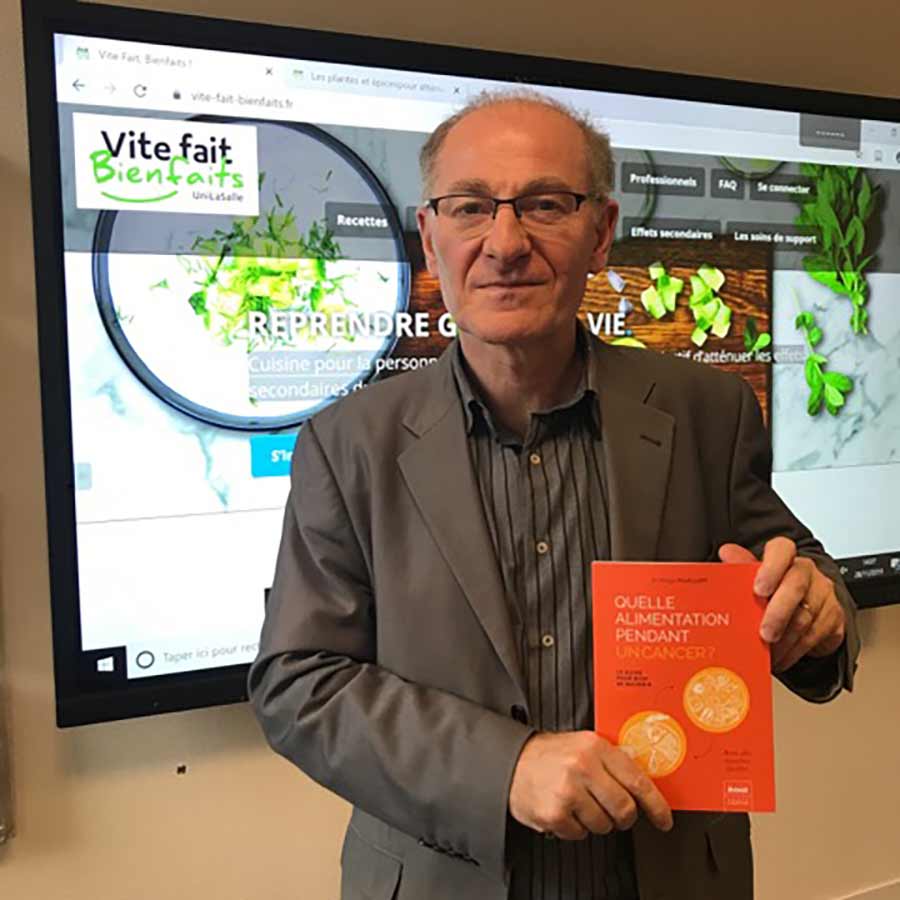
The book has finally arrived, following the website. *Eating Well to Live Better While Battling Cancer* is co-written with 35 top chefs—Michelin-starred chefs, *Top Chef* contestants, world champions, and more—all of whom are his friends whom he regularly meets through the culinary associations he belongs to. Each contributed a recipe. “A Michelin-starred recipe—impossible to make, expensive, time-consuming. And then, it’s up to me. ” He reworks each dish to make it suitable for everyday cooking. The recipe always addresses a specific symptom and retains what matters—fish rich in omega-3, for example—but the cost of the ingredients drops from 20 euros to 2 or 3, and the preparation becomes easy.
In 2026, the book will receive the award for the world’s best healthy cookbook.
Then the food and health students take it a step further. Last year, a class adapted the book’s 35 recipes for institutional food service in healthcare settings, simplifying them further and further—without compromising their effectiveness—so that hospitals could serve them in turn. A scientific publication is in the works, and their names will be cited in it. The need is real: institutional food service professionals send their teams to train at UniLaSalle and reach out to the school regarding bids for contracts with cancer hospitals.
Since 2010, Philippe Pouillart has always found a way to involve students—whether through coursework, capstone projects, or fixed-term contracts.
Néhôtel: The Next Chapter, Starting in 2027
The kitchen where onCOOK is filmed is just one room in the new HealthLab at UniLaSalle Beauvais, a program led by the Collège Santé that combines nutrition with adapted physical activity. That’s where the next phase is being prepared. The project is called Néhôtel: “néo,” one of the names doctors give to cancer, and “hôtel.” It will launch in early 2027. “It’s a hotel service, nothing more, nothing less.” Rooms to accommodate patients referred by the partner hospital for four days, very early in their treatment journey, to explain the risks of malnutrition and empower them to take an active role in their care. Right next door is a smart kitchen and a digital restaurant, whose walls can display the decor of a dining room or a landscape. Upstairs, there’s a social and aesthetic care lounge, a digital wall that guides physical exercises designed by healthcare professionals… in short, a whole world of pampering!
Here, too, patients will be actively involved. “You heard right: they’re active participants, so they work.” And once again, the school will have to prove its claims through a clinical study currently being developed with Flore Depeint, Claude Narcisse Niamba, Alexandra Bibard, and Emma Cogo.
The first results of the onCOOK study are expected at the midpoint, sometime in 2027. He refuses to say more: “That would be presumptuous.” What he can say is that traffic to the site surges with every workshop, and that partnership requests—from organizations and hospitals alike—are pouring in from all over (Canada, Belgium, Switzerland, …).
The session comes to an end. Connections are closing one by one, from Beauvais to the Caribbean. In the HealthLab kitchen, the teaspoons are put away in the right drawer.
What’s the point of all this, thirty years later? “I’m happy to see all these people coming and coming back, saying it makes them feel good. And it makes the team feel good, too.” Then he returns to the locked room, and to the words someone had said to him that day. “It was unbearable.” He turned it into a kitchen, a website, a monthly workshop, a book, and soon a hotel. And a conviction he’s been repeating for fifteen years—one that the giants of institutional food service are now coming to Beauvais to seek out: eating is part of care, and cooking is an extension of the medical prescription; culinary medicine, in short.
Further Reading
Quick & Easy Health Tips: a free website featuring recipes and tips organized by symptom
onCOOK: a free online cooking workshop held one Friday a month from 3:00 p.m. to 5:00 p.m., open to patients, family members, and caregivers in mainland France and the overseas territories. The next session is on Friday, October 23 (dysphagia, or difficulty swallowing, and oral health issues), followed by November 20 (loss of appetite, nausea, and vomiting) and December 11 (digestive disorders).
Offered by UniLaSalle Beauvais with institutional support from Malakoff Humanis
The book: Eating Well for a Better Quality of Life During Cancer, by Dr. Philippe Pouillart, published by Privat, over 300 pages, linked to the Vite Fait Bienfaits website via QR codes


