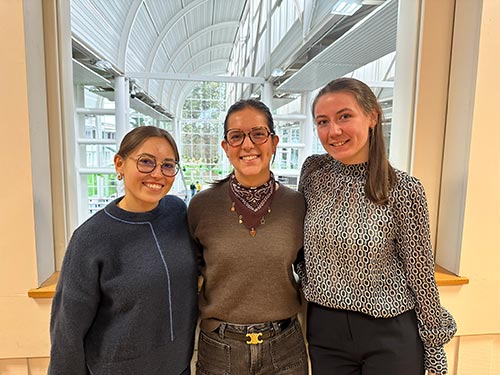
Three Food & Health students helped BTP Résidences médico-sociales (BTP RMS), a manager of facilities for the elderly, to create and run a culinary competition focusing on modified textures. An experience with a strong social impact.
From September to March, Lou Lagord, Laura Pons, and Tibhirine Amand took part in a unique event organized with BTP Résidences médico-sociales (BTP RMS), the PRO BTP group association that manages medical-social establishments for elderly and disabled people. The project brought together employees from nine different structures for a culinary competition focused on modified textures. Combining scientific rigor, culinary creativity, and a sense of care, this initiative immersed our students in the realities of the medical-social sector while highlighting their expertise as engineers in training.
The challenge: restoring taste, pleasure, and dignity to seniors' meals
In medical-social establishments, and particularly among the elderly, swallowing disorders and malnutrition are a daily challenge. Modified textures are essential to ensure continuity of daily food intake, but are often unattractive and perceived as monotonous by residents. However, the stakes are high: restoring appetite, pleasure, and dignity to the most fragile residents.
To meet this need, BTP RMS decided to bring together its chefs and employees for a unique culinary competition. The goal: to stimulate creativity, encourage more appealing presentations, and offer dishes that restore the desire to eat.
“Seeing that large medical and social groups want to improve the dining experience changes everything. We feel that our work in healthy eating is meaningful,” says Laura, who is in her final year of the program.
This ambition echoes the core of UniLaSalle's Food & Health Engineering program: combining science, pleasure, and support for vulnerable populations.
Three students involved in every stage of the project
Supervised by Philippe Pouillart, lecturer and researcher in culinary practices and health and member of the jury, alongside guest chef and Meilleur Ouvrier de France winner Stéphane Collet, the three students were involved from the very beginning of the event's conception.
Logistics, framing, coordination, monitoring the progress, and putting together activities: their work was varied, intense, and demanding.
“This project pushed us to draw on everything we've learned in our training: nutrition, project management, but also listening and adapting. We really saw the impact our skills can have,” says Lou.
Each week, they worked alongside BTP RMS to prepare a practical, demanding, and useful competition for both the teams and the residents.
A day of competition alongside medical and social care teams
On December 3, nine pairs—four in the morning and five in the afternoon—took over the culinary platform at UniLaSalle Beauvais to prepare a chopped dish and a blended dessert. The teams were made up of a chef and a professional from the establishment, thereby strengthening cooperation between the kitchen, care, and support teams.
The students set the pace for the day: coordinating the teams, keeping to the schedule, observing practices, providing logistical support, and leading a session on the enjoyment of food and the psycho-emotional role of meals in institutions.
"What struck me was the enthusiasm of the teams. They're not there to win, but to learn, share, and do better for their residents. This energy is perfectly in line with the values we uphold at Alimentation & Santé," says Tibhirine.
A booklet containing the recipes will then be compiled to promote the event and the chefs' involvement with families and caregivers, but also to provide long-term support to institutions in their culinary practices.
A professionalizing experience focused on meaning and training
This immersion in the heart of the medical-social sector gave students a concrete vision of the challenges in the field: logistical constraints, nutritional specificities, family expectations, and the balance between pleasure, safety, and health. They were able to gauge the social impact of their future profession and the direct impact that engineers can have on residents' quality of life.
The initiative also highlights the strength of the Lasallian model: proximity to partners, scientific and applied training, project-based teaching, and a commitment to fairer and more humane food practices.
By supporting BTP RMS in the implementation of this approach, Lou, Laura, and Tibhirine demonstrated the skills and sensitivity of future engineers trained at UniLaSalle: capable of taking action, innovating, understanding the needs on the ground, and providing concrete and meaningful solutions.